

Level 6 Diploma in Transpersonal Psychology
(RQF Level 6 – Bachelor’s Degree Level Study)
About the qualification:
The Level 6 Diploma is a part-time, one-year online programme.
It is designed and delivered through the British Transpersonal Association &
The Institute For Transpersonal Consciousness Education
Awarded through Crossfields Institute
Regulated by the Office of Qualifications and Examinations Regulation (Ofqual)
The Level 6 Diploma is part of the UK Regulated Qualifications Framework (RQF) and is internationally recognisable through the Ofqual-regulated UK qualifications system.
This Level 6 Diploma is positioned at the same academic level as final-year Bachelor’s degree study within the UK Regulated Qualifications Framework (RQF).
Rather than covering the full breadth of a traditional psychology degree (which typically consists of 360 credits across Levels 4–6 and may take 4–6 years part-time), this qualification offers 37 Level 6 credits representing advanced specialist study in Transpersonal Psychology
What is Transpersonal Consciousness Education?
Transpersonal Consciousness Education explores the development of human consciousness beyond purely reductionist models of mind and reality.
It integrates insights from Transpersonal Psychology, consciousness studies, phenomenology, neuroscience, philosophy, symbolism, contemplative practice, and human development to support deeper awareness, meaning, relational understanding, and conscious participation in life.
Rather than viewing education as the transfer of information alone, Transpersonal Consciousness Education approaches learning as a developmental and transformative process involving mind, body, imagination, emotion, relationship, and lived experience.
It encourages critical reflection on inherited assumptions, conditioned perception, and cultural narratives, while remaining grounded in open inquiry, scientific exploration, and experiential understanding.
At its core, Transpersonal Consciousness Education recognises that human beings are relational, meaning-making participants within a wider web of life, consciousness, culture, and nature.
This approach values:
-
lived experience alongside intellectual inquiry,
-
symbolic and imaginative ways of knowing,
-
embodied and relational learning,
-
curiosity, reflection, and ethical awareness,
-
and the cultivation of deeper capacities of consciousness.
The aim is not escape from reality, but the development of a more conscious relationship with self, others, nature, and existence itself.
In this sense, Transpersonal Consciousness Education continues a lineage stretching from Socratic inquiry and contemplative traditions through to contemporary consciousness studies - inviting human beings to participate more fully, creatively, and consciously in life.
Our mission is to provide transformative and developmentally grounded education that supports the exploration and cultivation of human consciousness beyond purely reductionist models of mind and reality.
Through the integration of Transpersonal Psychology, consciousness studies, phenomenology, neuroscience, symbolism, contemplative practice, and human development, we aim to support deeper awareness, meaning, relational understanding, and conscious participation in life.
We view education not simply as the transfer of information, but as a process of psychological, existential, and transpersonal development involving reflection, imagination, embodiment, inquiry, and lived experience.
Our work supports the development of practitioners, educators, leaders, and researchers seeking to contribute meaningfully within fields such as mental health, education, leadership, consciousness studies, spirituality, creativity, and end-of-life care.
At the heart of our approach is a commitment to cultivating more conscious relationships with self, others, nature, culture, and existence itself.
Training Programmes:
Level 6 Diploma in Transpersonal Psychology (Bachelors Degree Level)
For experienced professionals seeking accredited depth and rigour
This path is for you if you:
-
Are a practising psychotherapist, counsellor, psychologist, coach, or allied professional
-
OR have been working with people in a helping, care, facilitation, or leadership role for 5+ years
-
Want a formally recognised Level 6 qualification in Transpersonal Psychology
-
Are looking to integrate spirituality, meaning, and expanded states of consciousness into your existing professional framework - ethically and responsibly
About the qualification
-
This is an Ofqual-verified Level 6 Diploma
-
Level 6 study is equivalent in academic level to a Bachelor’s Degree
-
It is designed to complement existing professional training
What this pathway offers
-
A rigorous Transpersonal Psychology curriculum grounded in research, theory, and ethics
-
In-depth exploration of spirituality, development, neuroscience, and non-ordinary states of consciousness
-
Language and conceptual frameworks that allow you to speak credibly across clinical, academic, and spiritual contexts
-
A recognised qualification that supports professional credibility and progression
Typical outcomes
-
Enhanced depth, confidence, and coherence in your current professional role
-
A formal transpersonal specialism you can ethically integrate into your work
-
A strong academic and reflective foundation for further practitioner or research pathways if desired
This training is for:
Practising psychotherapists, counsellors, psychologists, coaches, supervisors, educators, hospice and end-of-life professionals, and experienced facilitators.
Intended Learning and Transformational Outcomes
This programme is designed to deepen critical inquiry into the nature of human consciousness through transpersonal, psychological, philosophical, and experiential perspectives.
As a graduate of the programme, students should be able to:
-
Think critically and reflectively about consciousness, perception, and human development
-
Engage expanded and transformative experiences with greater grounding, discernment, and self-awareness
-
Explore connections between psychology, spirituality, philosophy, and consciousness studies
-
Support ethical meaning-making and integrative reflection in self and others
-
Navigate the relationship between psychological and spiritual experience with greater sensitivity and nuance
-
Cultivate embodied, relational, and reflective approaches to human development and well-being
-
Integrate transformative insight into everyday life, relationships, and professional practice
Click here to see the course brochure
The Level 6 Transpersonal Psychology Diploma now includes an additional certified mini-course:
AI in Therapy: A Developmental and Transpersonal Approach& Therapy
Click here to read the Level 6 Qualification Specification
Click here to read: Reflections from Our Level 6 Students
What makes BTA’s approach to consciousness studies different from a traditional psychology degree?
BTA approaches consciousness through an integrated transpersonal framework that brings together psychology, consciousness studies, neuroscience, philosophy, spirituality, symbolism, and expanded states of awareness.
Alongside academic inquiry, the programme includes reflective, experiential, and developmental dimensions designed to support deeper engagement with human consciousness and meaning-making.
Is this programme only for spiritual people?
No. The programme is open to people from academic, philosophical, therapeutic, creative, educational, psychological, and reflective backgrounds.
Spirituality is explored not as a fixed belief system, but as a dimension of human experience concerned with meaning, connection, transcendence, ethics, and existential inquiry.
Students are encouraged to approach all material critically, reflectively, and experientially.
Does BTA study consciousness scientifically or spiritually?
Our approach explores consciousness through multiple perspectives, including psychology, neuroscience, phenomenology, contemplative traditions, transpersonal psychology, thanatology, and consciousness research.
Rather than privileging a single worldview, the programme encourages critical inquiry into the nature of consciousness, human experience, transformation, and meaning.
The aim is not to promote fixed beliefs, but to cultivate thoughtful, grounded, and integrative exploration.
In which professions can I use a Transpersonal Psychology Level 6 Diploma?
This training is a foundational developmental education for future human-centred work and covers the following areas:
Training Fee: £4,500
(payment plans are available)
To register interest for the
September 2026 Level 6 Programme
please fill in the form below
Mental Health & Wellbeing
The Level 6 Diploma in Transpersonal Psychology supports pathways connected to mental health,
wellbeing, and human development.
This includes counselling pathways, psychotherapy pathways, coaching, youth mental health support, wellbeing facilitation, holistic health work, trauma-informed support roles, community mental health initiatives, and peer-support facilitation.
What makes the programme distinctive is its integrative approach to understanding the human experience.
Alongside psychological theory, the diploma explores areas such as consciousness, symbolism, meaning-making, nervous system awareness, spirituality, developmental psychology, and existential wellbeing.
As modern mental health challenges increasingly involve issues such as anxiety, identity fragmentation, loneliness, burnout, digital overwhelm, and meaning crises, there is growing recognition that many individuals require approaches that go beyond symptom management alone.
The programme encourages students to explore the wider psychological, relational, philosophical, and existential dimensions of wellbeing while developing reflective, ethical, and human-centred perspectives.
The diploma may therefore offer valuable foundations for those wishing to contribute to emerging wellbeing professions that integrate psychological understanding with compassion, relational depth, critical thinking,
and broader perspectives on human flourishing.
Youth & Community Work
This may become one of the strongest future-facing areas for graduates of the Level 6 Diploma in Transpersonal Psychology.
The programme offers valuable foundations for youth work, mentoring, pastoral care, alternative education, student wellbeing, community leadership, group facilitation, restorative practice, and
consciousness-informed education.
This is especially relevant as younger generations increasingly face challenges such as anxiety, identity fragmentation, loneliness, digital overwhelm, and crises of meaning. The diploma helps develop the psychological, philosophical, relational, and reflective capacities needed to support young people in navigating these complex transitions into adulthood.
Education & Human Development
The diploma also supports pathways connected to teaching, educational support, creative education, philosophy and ethics facilitation, consciousness education, emotional literacy work, developmental facilitation, and human flourishing programmes.
As education increasingly moves into an AI-shaped future, there is growing recognition that young people require more than information and technical skill alone. Future educational systems are likely to place greater value on psychological literacy, relational intelligence, creativity, symbolic understanding, nervous system awareness, ethical reflection, and meaning-centred development - all areas explored within the programme.
Creative & Media Fields
The Level 6 Diploma may also support individuals interested in future-facing creative professions, including writing, filmmaking, storytelling, documentary work, consciousness media, mythopoetic art, podcasting, ethical media creation, narrative design, gaming, and immersive storytelling.
As AI-generated content becomes increasingly common, the world will continue to need creators capable of producing meaningful, psychologically aware, emotionally resonant, and human-centred narratives. The programme encourages symbolic thinking, imagination, creativity, and reflective depth, offering a strong foundation
for emerging creative pathways.
AI, Technology & Human Flourishing
One of the most distinctive aspects of the programme is its exploration of consciousness, psychology, and human development within the context of rapidly advancing AI systems.
Future-facing pathways connected to this area may include AI ethics, digital wellbeing, human-centred technology, consciousness studies, ethical leadership, human flourishing research, technology and society consultancy, and future education design.
Very few educational programmes currently bridge psychology, consciousness, philosophy, ethics, spirituality, and AI culture in an integrated way.
The Level 6 Diploma offers a unique opportunity to explore these questions while developing critical, reflective, and relational capacities that remain deeply human.
Conscious Leadership & Organisational Culture
The diploma supports pathways connected to leadership development, team facilitation, organisational wellbeing, ethical entrepreneurship, community building, values-based leadership, and human-centred business culture.
As automation increasingly transforms the workplace, deeply human capacities such as empathy, ethical discernment, symbolic understanding, relational intelligence, and participatory leadership are likely to become more valuable across professional settings.
End-of-Life & Meaning-Centred Work
The programme also aligns strongly with emerging areas connected to end-of-life and meaning-centred support work. This may include hospice support, end-of-life companionship, bereavement support, spiritual care, conscious dying initiatives, grief-informed community work, and meaning-centred approaches to wellbeing.
Few people are currently given psychologically healthy frameworks for engaging with mortality, grief, existential reflection, and the deeper questions surrounding human life. The programme offers opportunities to explore these areas thoughtfully, compassionately, and developmentally.
Level 7 Diploma in Transpersonal Psychology (Masters Degree Level)
A one-year programme, Beginning June 2026
The Level 7 Diploma is designed as a natural progression for graduates of the Level 6 Diploma in Transpersonal Psychology, who have already completed foundational study in areas such as neuroscience, neurobiology, spirituality, thanatology and transpersonal practice.
However, the programme also recognises that individuals from related academic or professional backgrounds may possess equivalent preparation for postgraduate study. For this reason, the Level 7 Diploma may be accessed through the following routes:
-
Progression from the Level 6 Diploma in Transpersonal Psychology: learners who have successfully completed the Level 6 Diploma may progress directly onto the Level 7 programme.
-
Direct entry from related fields: applicants who hold relevant qualifications or professional experience in related areas – such as psychology, counselling, philosophy, neuroscience, consciousness studies, spiritual care or other aligned disciplines – may also be considered.
-
Prior learning: applicants may be able to demonstrate readiness for Level 7 study through evidence of prior academic work, practitioner experience, reflective writing or research engagement. Where appropriate, applicants entering through this route may also be asked to complete preparatory reading or bridging work to ensure familiarity with key transpersonal frameworks before beginning the programme.
Please Click Here for the Level 7 Qualification Specification
Crossfields Institute is an educational organisation and Degree Awarding Body recognised by the Governmental Office of Qualifications and Examinations Regulation (Ofqual).
Ofqual Qualification Number: 610/7405/6
The training is designed and delivered by the British Transpersonal Association, with Crossfields providing external oversight and supporting the integrity of the qualification process.
For more information please contact: Diane.ellliott@britishtranspersonalassociation.org
FRAMEWORKS
Six Pillars of Learning:

1. Neuroscience
Understanding the brain as the organ of perception, meaning, and relationship
This pillar explores how brain structure and function shape perception, identity, and experience. Drawing on contemporary neuroscience and hemispheric research, students examine how attention, narrative, emotion, and awareness are organised in the brain - and how different modes of consciousness arise. Emphasis is placed on integration rather than reduction, supporting a nuanced understanding of mind and meaning.
2. Neurobiology
The lived body as the foundation of experience and regulation
Neurobiology focuses on the embodied nervous system and its role in safety, threat, connection, and regulation. Students explore autonomic states, neuroception, and relational biology, learning how psychological and spiritual experiences are shaped by physiological processes. This pillar grounds transpersonal work in the body, supporting ethical, stabilising, and integrative practice.
3. Spirituality
The psychological study of meaning, values, and transcendence
This pillar examines spirituality as a universal human dimension rather than a belief system. Students explore spiritual development, spiritual competencies, and the role of meaning, purpose, and values in psychological wellbeing. The focus is on ethical engagement with spiritual experience across cultures and worldviews, without dogma or belief imposition.
4. Thanatology
Death, dying, grief, and existential meaning
Thanatology addresses the psychological, cultural, and spiritual dimensions of death and loss. Students study grief processes, end-of-life ethics, death anxiety, and the concept of a “good death,” alongside sociological and historical perspectives. This pillar supports mature engagement with mortality as a central dimension of human meaning and transformation.
5. Post-Life Consciousness
Critical inquiry into consciousness beyond the individual lifespan
This pillar explores theories and research concerning the continuation of consciousness after death. Students engage critically with near-death experiences, out-of-body experiences, cross-cultural afterlife beliefs, and philosophical debates surrounding the nature of consciousness. The emphasis is on open inquiry, epistemological humility, and psychological impact rather than metaphysical certainty.
6. Modalities
Ways of knowing, exploring, and integrating experience
The Modalities pillar introduces a range of transpersonal, symbolic, contemplative, and reflective approaches used to explore inner experience. These are studied theoretically and contextually, with attention to ethics, scope, and integration. The focus is not on technique mastery, but on understanding how different modalities support meaning-making, regulation, and psychological development.
Practical:
Creativity, Expressive Arts and Ecotherapy
Transpersonal Hypnotherapy
Jungian Active Imagination and Archetypal/Symbolic Exploration
EMDR
Meditation
Somatic Sensing
Intuition and Flow Writing
Philosophical Exploration
Dream Work
Breathwork
Plant Medicine
Theoretical:
Mystical Experiences are the encountering of transcendence, unity, or connection with a higher power or the cosmos.
These experiences are spontaneous (such as a Near-Death Experience, or a Shared-Death Experience) or intentional such as breathwork, sensory deprivation, or the use of plant medicines.
In essence
Together, the Six Pillars form an integrated framework that brings together brain, body, meaning, mortality, consciousness, and method - supporting a grounded, ethical, and expansive approach to
Developmental Transpersonal Psychology.
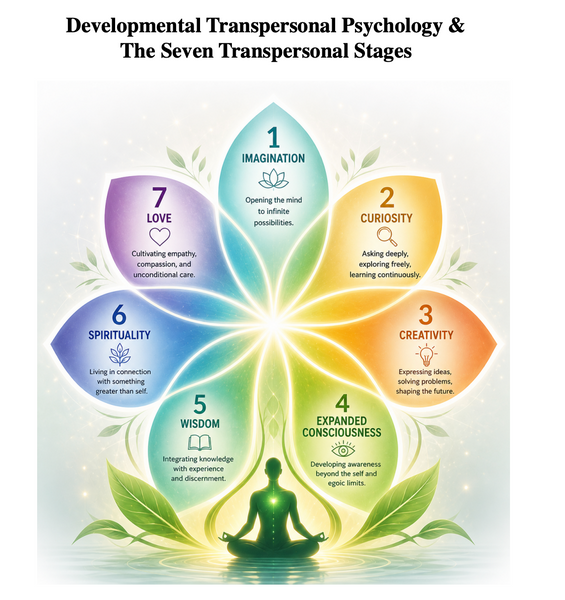
The Seven Transpersonal & Consciousness Principles
The Seven Transpersonal Principles are stages that describe the developmental unfolding of human consciousness - from imagination and curiosity through to wisdom, spirituality, and love.
Rather than viewing consciousness as fixed, this framework explores how awareness can deepen through symbolic insight, creativity, expanded states, relational understanding, and lived experience.
Together, the stages form a developmental pathway for Transpersonal Consciousness Education, supporting the cultivation of meaning, self-awareness, ethical presence, and conscious participation in life.
Principle 1: IMAGINATION
The Imaginal Dimensions of Consciousness
Transpersonal awakening begins by restoring our fuller spectrum of knowing. Through the imaginal realm — where image, intuition, symbolism, and embodied insight converge — we reawaken the relational, intuitive, and meaning-making dimensions of consciousness.
Principle 2: CURIOSITY
Consciousness Drawn Toward Meaning
Curiosity initiates the seeker’s path — the movement of consciousness toward something beyond the conditioned egoic self. This is the beginning of inquiry, the first stirrings of Transpersonal Intelligence. The longing for meaning, healing, purpose, and transcendence reflects a developmental impulse within human consciousness itself.
Principle 3: CREATIVITY
Consciousness Becoming Expressive
Creativity is the moment when inner consciousness seeks form in the world. What once stirred invisibly within now moves toward expression through image, language, movement, relationship, or ritual — making inner experience visible, shareable, and transformative.
Principle 4: EXPANDED STATES OF CONSCIOUSNESS
Beyond Consensus Awareness
A person opens to altered and expanded modes of consciousness through practices such as meditation, dreams, Transpersonal Inquiry, psychedelics, contemplative states, or spontaneous insight. These experiences can reveal dimensions of reality that extend beyond ordinary perception, requiring grounding, reflection, and integration.
Principle 5: WISDOM
The Maturation of Consciousness
Wisdom is not merely the accumulation of knowledge, but the maturation of consciousness itself. It reflects the capacity to discern truth through ethical awareness, relational depth, intuition, reflection, and compassionate presence. This developmental unfolding forms the basis of Transpersonal Intelligence.
Principle 6: SPIRITUALITY
Consciousness in Relationship with the Sacred
Life is experienced not as random or purely mechanistic, but as infused with symbolic, archetypal, and sacred meaning. Consciousness begins to recognise itself as participating within a larger web of life, relationship, mystery, and existence.
Principle 7: LOVE
Consciousness as Relational Wholeness
The culmination of transpersonal development reveals love not as sentimentality, but as a mode of conscious being. Love becomes an embodied relational presence — a lived awareness of connection with self, others, nature, and life itself. From this place, love is no longer something merely felt or exchanged, but recognised as the ground of shared existence.

A Framework for Transpersonal Capacity Cultivation
The Seven Transpersonal Stages describe how consciousness can expand, deepen, and mature over time. AIME describes how those shifts in consciousness become integrated into lived experience.
While the stages map what unfolds developmentally, AIME attends to how expanded awareness becomes embodied, metabolised, and ethically lived. It supports the movement from insight to integration — helping imagination become creativity, experience become wisdom, and expanded consciousness become grounded relational presence.
In this way, AIME functions as an integration process running through all seven stages, regulating pace, supporting meaning-making, and helping transformative shifts in consciousness stabilise into enduring inner capacities.
What AIME Stands For
A – Aspects: Shifting the mode of attention
Cultivating a quality of attention that is patient, grounded, and non-intrusive.
Rather than analysing or interpreting experience, attention is gently re-oriented so that experience can be met directly and meaning can emerge organically.
I – Into: Dropping into the felt, experiential field
Moving into the lived, embodied, and experiential dimension of consciousness.
This includes symbolic and imaginal dimensions of experience, which are treated as legitimate modes of knowing — allowing inner material to be approached indirectly, safely, and creatively.
M – Metaphor: The symbolic dimensions of consciousness reveal themselves through metaphor, image, and resonance.
Supporting the person to encounter meaning as it arises through metaphor, image, or symbolic pattern.
Meaning is not imposed, explained, or interpreted by the practitioner, but allowed to form through reflection, resonance, and integration.
E – Emergence: Integration at a sustainable pace.
Allowing insight, understanding, or integration to arise at the pace the system can sustain.
Emergence is respected as a developmental process — something that unfolds over time, rather than something to be forced, accelerated, or extracted.
The Core Principle of AIME
Development is not measured by the intensity of altered states,
but by the maturity of consciousness and capacity they leave behind.
AIME works on the understanding that:
-
Spiritual emergence can become spiritual emergency when experience outruns the system’s capacity to integrate it.
-
Insight that loops back into story, identity, or specialness without becoming embodied capacity leads to stagnation, spiritual fatigue, or inflation.
-
Unintegrated spiritual experience can quietly reinforce ego structures, giving rise to forms of spiritual narcissism where identity expands, but maturity does not.
-
Integration requires time, containment, humility, and relational safety, not intensity or acceleration.
AIME therefore functions as a regulator of pace, ensuring that experience unfolds in a way that can be embodied, lived, and expressed ethically - rather than accumulated, performed, or used to bolster identity.
How AIME Is Used
AIME may be used to:
-
support reflection on spiritual or existential experiences
-
work with symbolic or imaginal material
-
slow down meaning-making when experience feels overwhelming
-
cultivate discernment, grounding, and integration
-
support ethical accompaniment rather than interpretation
It is not a technique, intervention, or method for inducing altered states.
In Practice
AIME supports practitioners to:
-
listen beneath narrative
-
work with metaphor rather than explanation
-
prioritise capacity over content
-
remain ethically neutral and non-directive
-
avoid spiritual bypassing or premature interpretation
It refines the practitioner’s way of attending, not their toolbox.
In Essence
AIME is a framework for:
-
slowing down transformation
-
protecting integration
-
cultivating depth without destabilisation
-
allowing meaning to emerge rather than be imposed
It is especially relevant in contexts involving:
-
spiritual emergence
-
grief and loss
-
existential questioning
-
non-ordinary or transpersonal experience
What is a Transpersonal Practitioner?
A Transpersonal Practitioner works alongside individuals or groups to explore psychological experience within its wider existential, relational, symbolic, and spiritual dimensions.
Rather than focusing solely on symptoms or pathology, transpersonal practice also attends to:
-
meaning and identity
-
values and worldview
-
spirituality and existential questioning
-
human development and transformation
-
the person’s capacity for integration, reflection, and growth
The practitioner’s role is not to interpret, direct, or induce experience, but to offer grounded presence, ethical containment, reflective inquiry, and integrative support.
Working with Spiritual and Transpersonal Experience
Transpersonal practitioners may accompany individuals who are:
-
exploring spiritual or existential experiences
-
navigating periods of spiritual emergence or disorientation
-
reflecting on meaning, identity, purpose, grief, or transformation
-
integrating expanded or non-ordinary states of consciousness
The emphasis is on:
-
listening without imposing belief
-
supporting integration rather than amplification
-
encouraging grounding, reflection, and discernment
-
recognising when containment, stabilisation, or referral may be appropriate
The approach values open inquiry, psychological safety, and epistemological humility rather than certainty or dogma.
End-of-Life, Grief, and Existential Transition
From a transpersonal perspective, experiences such as grief, mortality, and existential transition are understood not only as psychological events, but as deeply human encounters with meaning, identity, relationship, and consciousness.
Practitioners may support individuals and families by:
-
holding space for reflection and meaning-making
-
supporting dignity, presence, and relational connection
-
acknowledging symbolic, spiritual, or transpersonal experience without literal interpretation
-
accompanying rather than directing the process
-
working alongside — not instead of — medical, psychological, or clinical care
The focus is on accompaniment, integration, and compassionate presence rather than treatment or intervention.
Trauma and Transpersonal Sensitivity
Transpersonal practitioners do not treat trauma unless they hold appropriate clinical qualifications and scope of practice.
However, transpersonal understanding may inform practice through:
-
recognising the existential and spiritual impact of trauma
-
avoiding spiritual bypassing or premature meaning-making
-
supporting grounding, pacing, nervous system safety, and stabilisation
-
acknowledging symbolic or archetypal material that may emerge within experience
-
collaborating appropriately with clinical professionals when required
Ethical transpersonal practice prioritises:
-
scope awareness
-
relational safety
-
nervous system regulation
-
professional boundaries
-
humility and ongoing reflective practice
In Essence
A Transpersonal Practitioner:
-
accompanies rather than directs
-
supports integration rather than experience-seeking
-
honours spirituality without imposing belief
-
values reflection alongside lived experience
-
works within clear ethical and professional boundaries
This approach is particularly relevant in contexts involving:
-
grief and loss
-
end-of-life transitions
-
meaning and identity change
-
spiritual emergence
-
existential questioning
-
expanded states of consciousness